
The Outer World
Those who land on hope come from other places. That’s the way it was, anyway. Recently, there have been those who were born on Hope. And so, knowing that they may never see where we came from, it becomes important to document the world outside.
While there is a vast world to be found, for our purposes we focus on just some of the larger players.
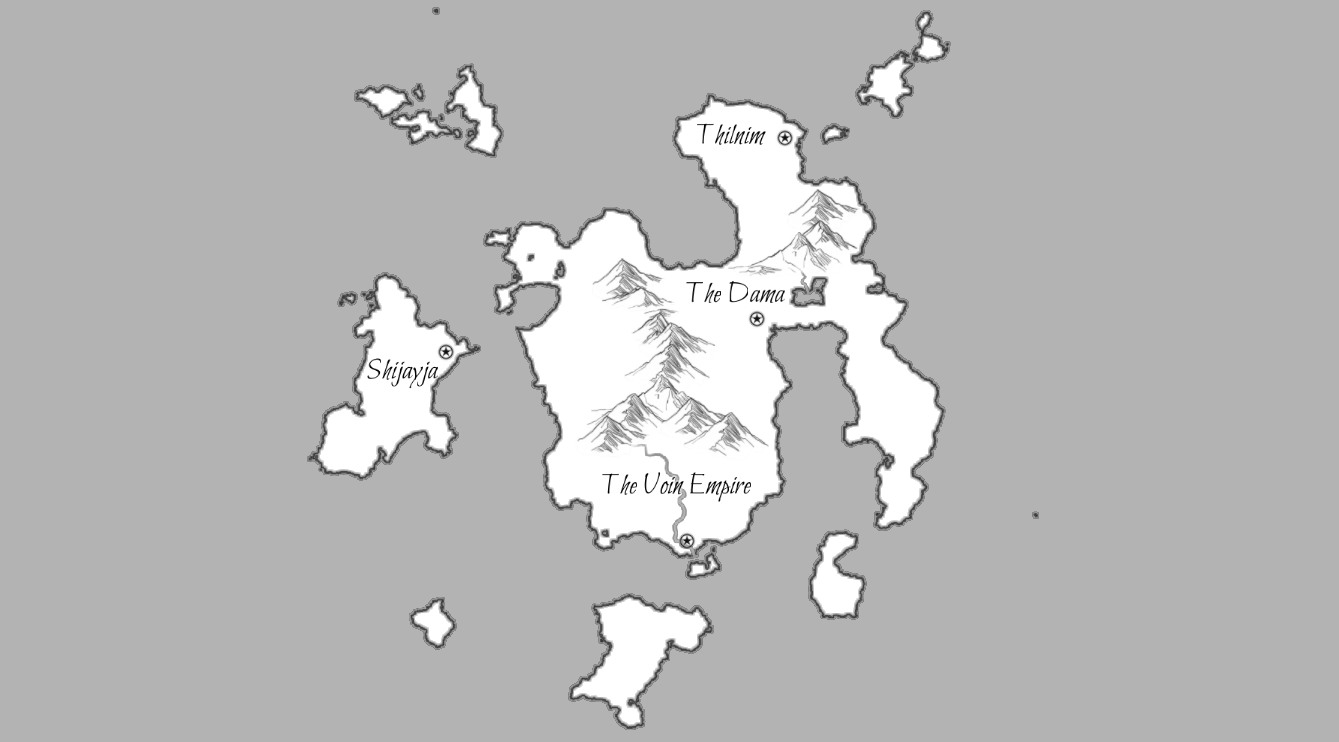
The Voin Empire
The Voin Empire is historically one of our most important players. Centuries ago, the empire managed to unify the known world under a single banner. While memory of this is now often pushed down, and the empire only remains in the south, the aftermath of this conquest is still found in our trading language and our shared cultures.
The Empire now still unifies itself under one banner, with their emperor at the top. Culturally, there is a great reverence for history, something that others have downplayed as nostalgia for a time when the Empire still held more sway.
This focus on history is also seen in the way most worship their gods. Newer, humanoid gods are almost entirely ignored, often withering away in their attempts to get a sway in the regions. Meanwhile old gods are heavily appreciated, and artisanship is seen as one of the highest merits one can achieve.
Shijayja
On the western continent there is a large unified force that grew from the Voin Empire after their conquest inevitably failed. Shijayja is best described as a vast land of many communal cultures, united in a council who meet each other once each tenth moon on the east coast of the continent.
While the council exists to bring diplomatic resolutions to internal conflicts, it is not uncommon for conflicts to be fought and won before the council can meet.
It would be naive to ascribe singular cultural traits to the entire continent, with vast differences in acceptance of gods and the arcane. However one thing became clear after the failure of conquest: despite their differences, the people of Shijayja are capable of uniting and protecting each other.
The Dama
To the centre of our map, all the way down to the peninsula down in the south east, we have what is often referred to as simple “The Dama”. The Dama is a group of hundreds of smaller and larger nations, each with their distinct identity. They function somewhat similarly to the Shijayja, although at a different scale.
Unlike the Shijayja, the nations within the Dama are organized in different kinds of structures. While some of them are kingdoms, others have taken on forms of democracy. Other regions live in states of relative anarchy, and have little sway within the overall political landscape of the region.
Conflicts happen often, though land borders tend to be respected. Conflict is most often waged over religious ideals, which due to the wide acceptance (and denial) of gods within the nation states in the Dama, differ frequently.
The unifying factor for the entire region lies in its ongoing war with the Empire. Blood is constantly being shed on the borders, with some historians presenting records from the day the Empire’s conquest failed.
Thilnim
Compared to the rest of the world, Thilnim is a quiet place. There is little conflict between people or states, and unity reigns within its people. Situated on the northern peninsula, the military state came into existence after Jahtri landed on the mountains in the south of the region.
With the war against the god lasting a hundred years – some centuries after the failed conquest –, the people of the region united in their struggle and generations of them were born only knowing the struggle.
Even after their war, with the descendants of the god now running rampage, the land remained hostile. And so the descendants of the warriors that once fought the god chose to reject most other gods, except for the ones they could tame.
It should be no surprise then that the culture of Thilnim focuses greatly on strength, determination, and self-supporting survival. While other professions are valued, the country needs many warriors and organizes its leadership from its most prestigious warlords.